Please contact Lynn Gallice, Shoreline Technician to inquire about water management options and information by calling 320-983-2160 or emailing lynn.gallice@millelacsswcd.org.
What is a well?
A well is a hole drilled into the ground to access water contained in an aquifer. An aquifer where water is stored in the ground and lives right below the water table. A pipe and a pump are used to pull water out of the ground, and a screen filters out unwanted particles that could clog the pipe. Wells come in different shapes and sizes, depending on the type of material the well is drilled into and how much water is being pumped out. (Groundwater.org)
What is well-sealing?
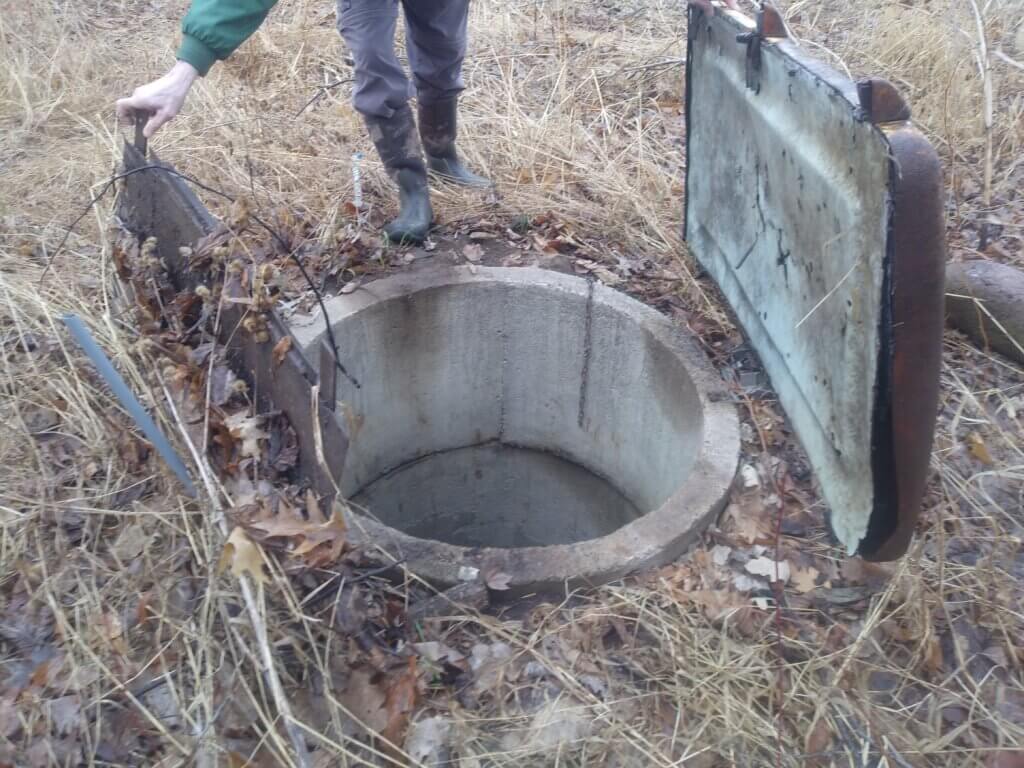
All resides in Mille Lacs County get their drinking water from groundwater found in underground geological formations called aquifers. An unused, unsealed well can provide an open channel between the surface and an aquifer, allowing polluted surface water to reach an uncontaminated aquifer. Unsealed wells threaten the quality of water in city wells, your neighbors well, or your own well. Large diameter dug wells can also be a serious safety hazard.
Frequently Asked Questions
1. Am I required to seal my unused well?
The simple answer is yes. According to Minnesota law, a well must be sealed if the well is not in use and does not have a maintenance permit. If you water your grass with water from an old well, it is considered to be “in use” and does not have to be sealed. The SWCD does not regulate unsealed wells and we will not report you for asking questions about your well. We are working to seal abandoned wells to keep everyone’s drinking water safe. Your well and your community’s drinking water safety are your responsibility.
2. Can I just seal it myself?
No! Only a well contractor licensed by the MN Department of Health may seal an unused well. Your contractor will issue you a Boring and Sealing Record that proves it has been properly sealed. Wells that have not been correctly sealed will still allow contaminants to reach your drinking water source. If you seal it yourself, you will be required to remove the material you have put into the well, and have it properly sealed. This can be very expensive! If you have already done this, we might be able to help.
3. Why is it important to seal my unused well?
Your unsealed well is a direct route for contaminants to reach your own drinking water source. Animals and people can fall into abandoned wells. Fertilizers, manure, runoff, pesticides, fuels, and solvents can enter unsealed wells and contaminate not only your drinking water source, but your neighbor’s as well.
4. Do I have an old well?
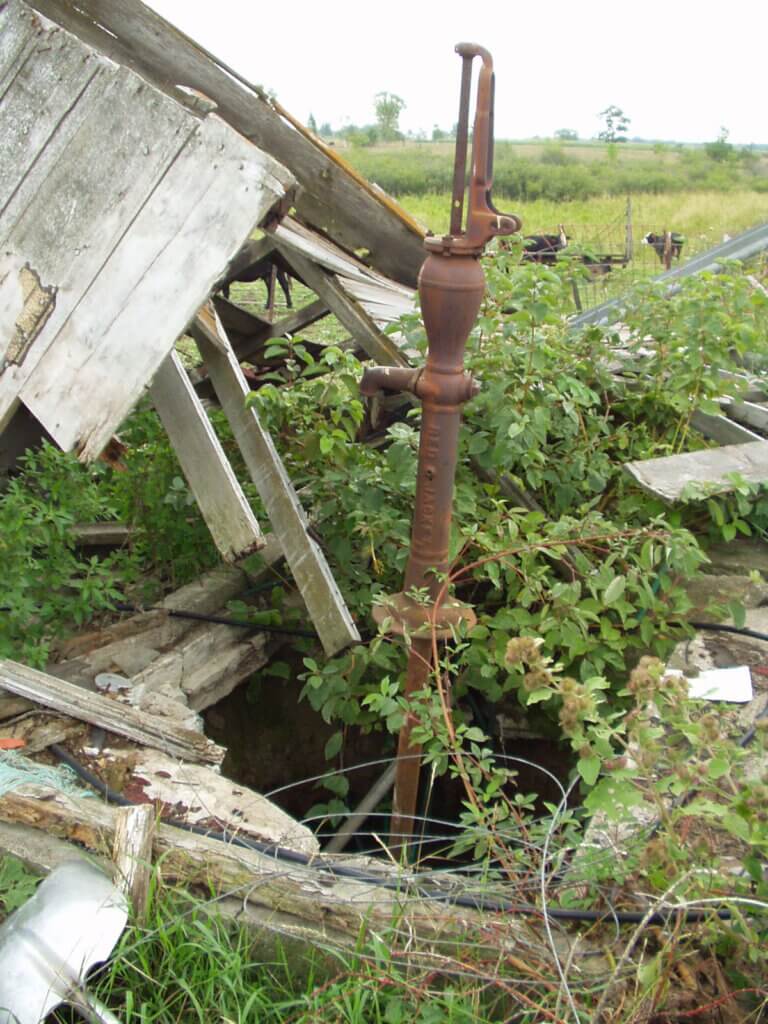
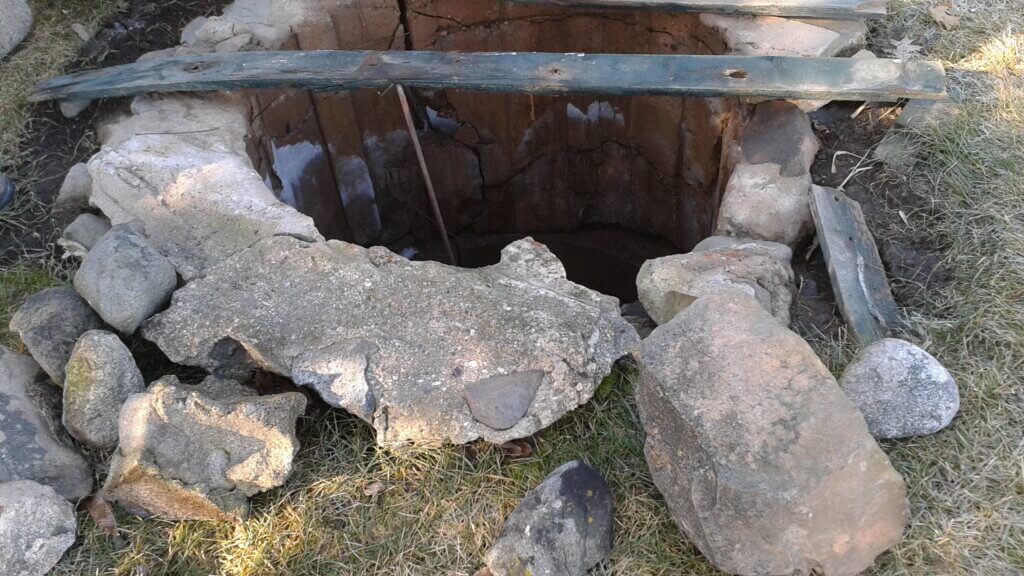
Maybe. Check in and near old barns. Look for holes covered with old pieces of metal or wood. Look for a low spot or sunken area in the ground. Old Need, goal, what we achieved as outcome, how we know we’ve achieved it.umps or well houses also indicate a well. Old wells can be indoors too. Look under a glass block in an exterior step. This indicates a small basement well room. Mysterious pipes sticking up out of your basement floor or yard could also indicate an old well.
5. Is there financial assistance available to help me seal my well?
Yes. The Mille Lacs Soil and Water Conservation District (SWCD) has financial assistance available for qualifying wells. For more details, give us a call at 320-983-2160.
Private Well Users Information from the Minnesota Department of Health
The two downloads below are from the Minnesota Department of Health
Water Testing
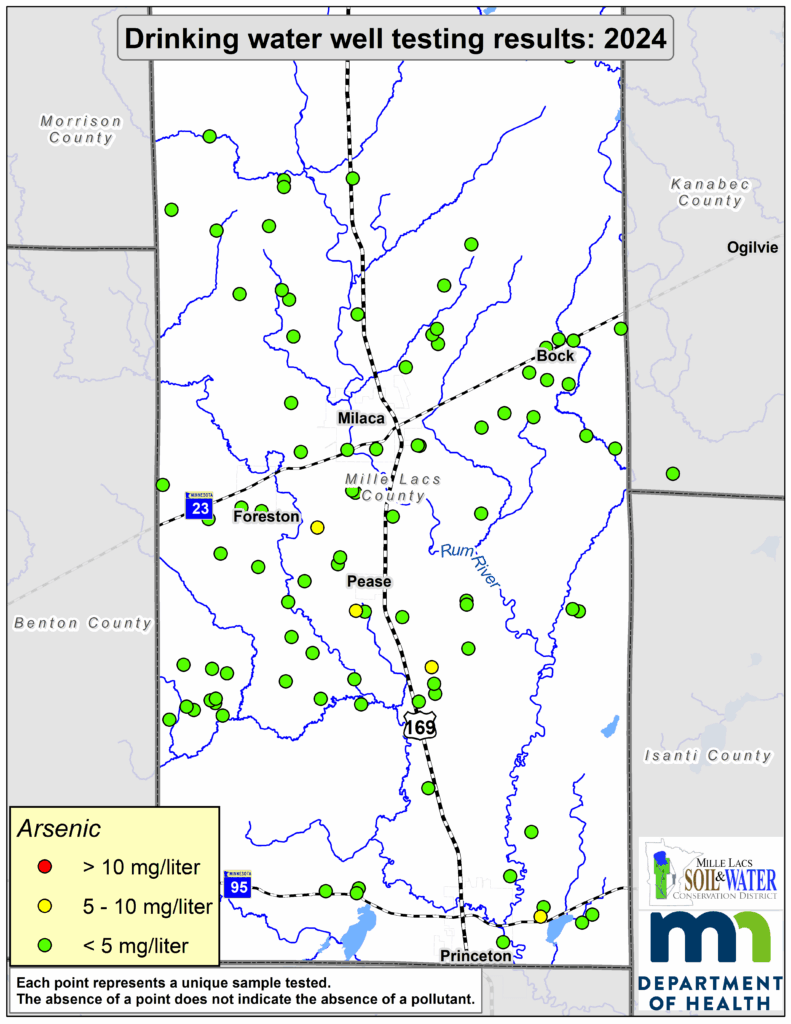
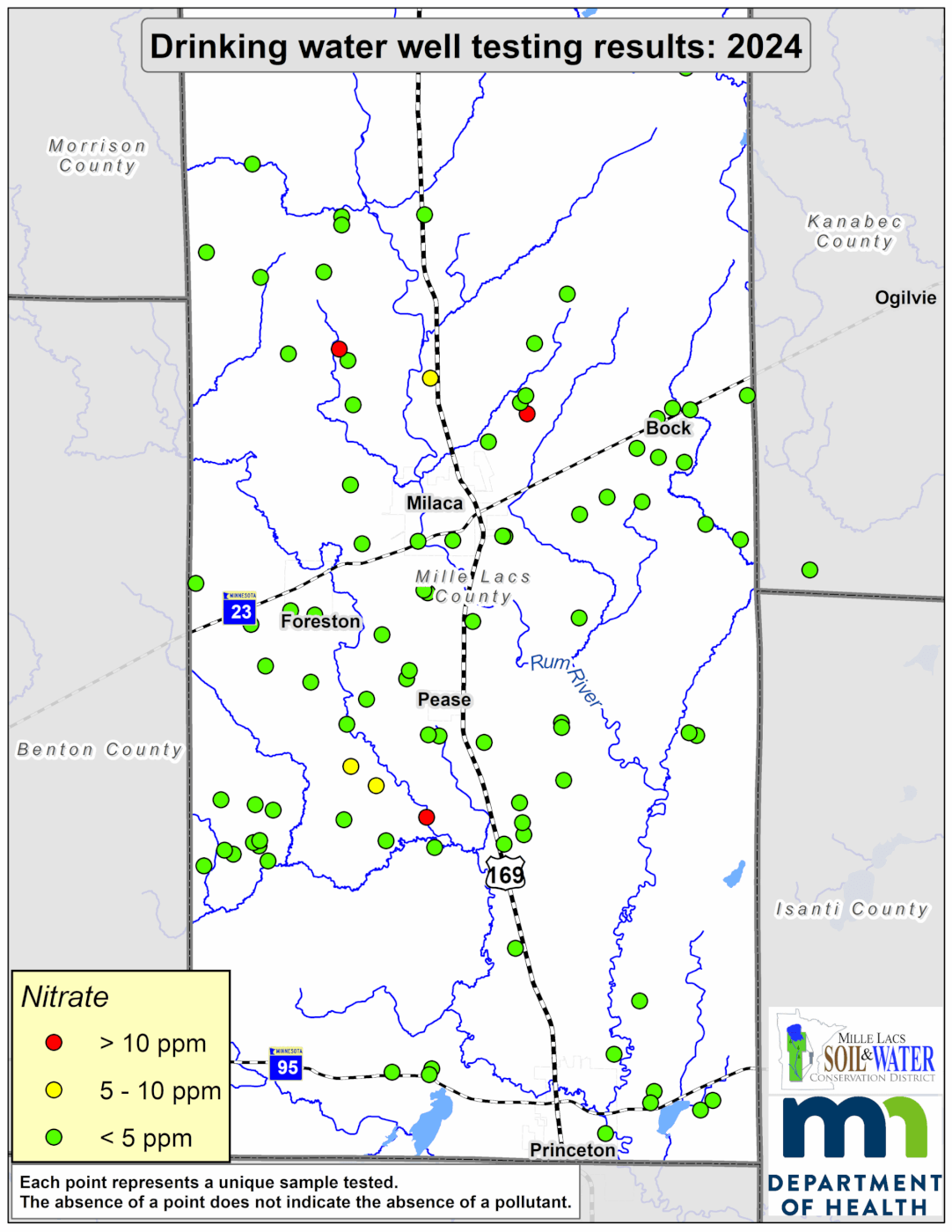
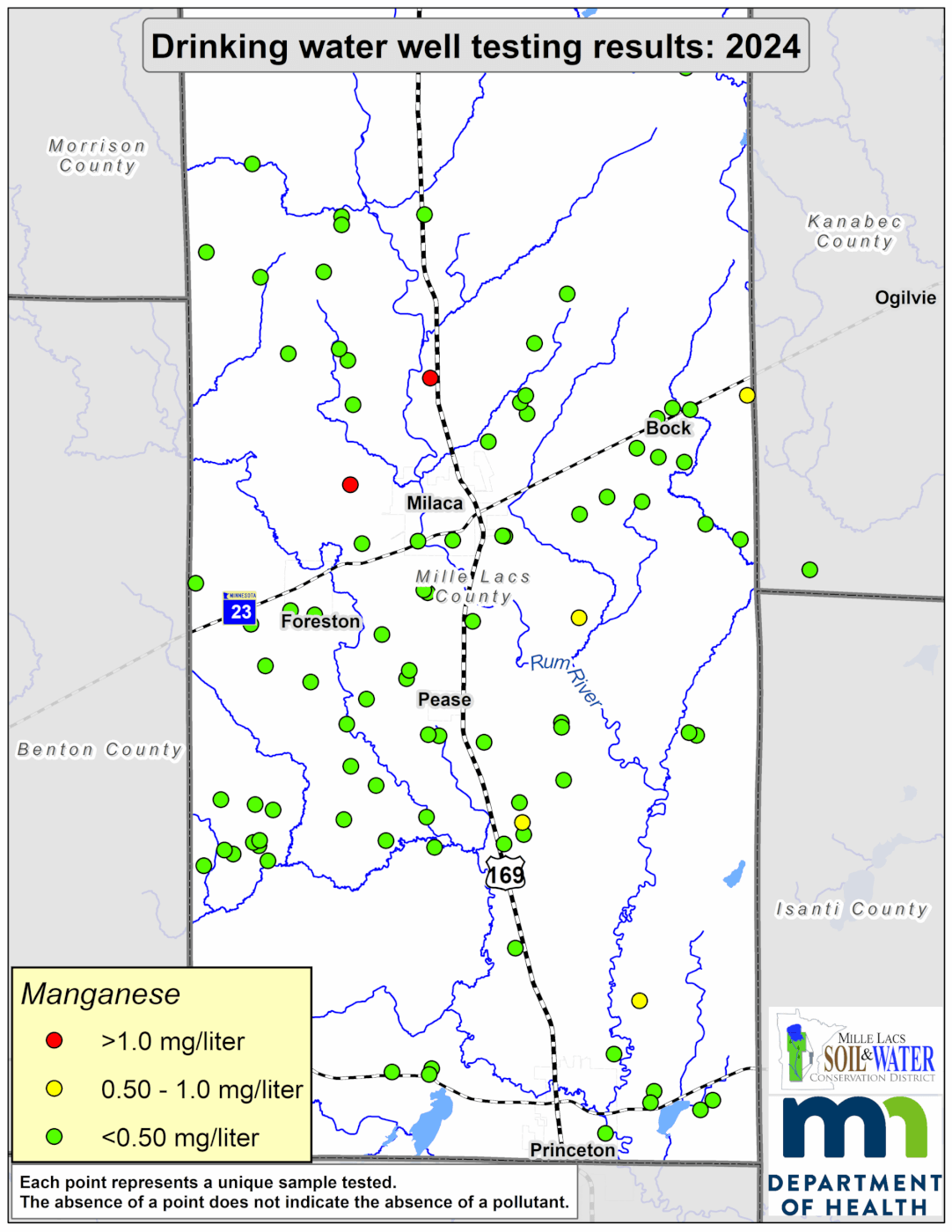
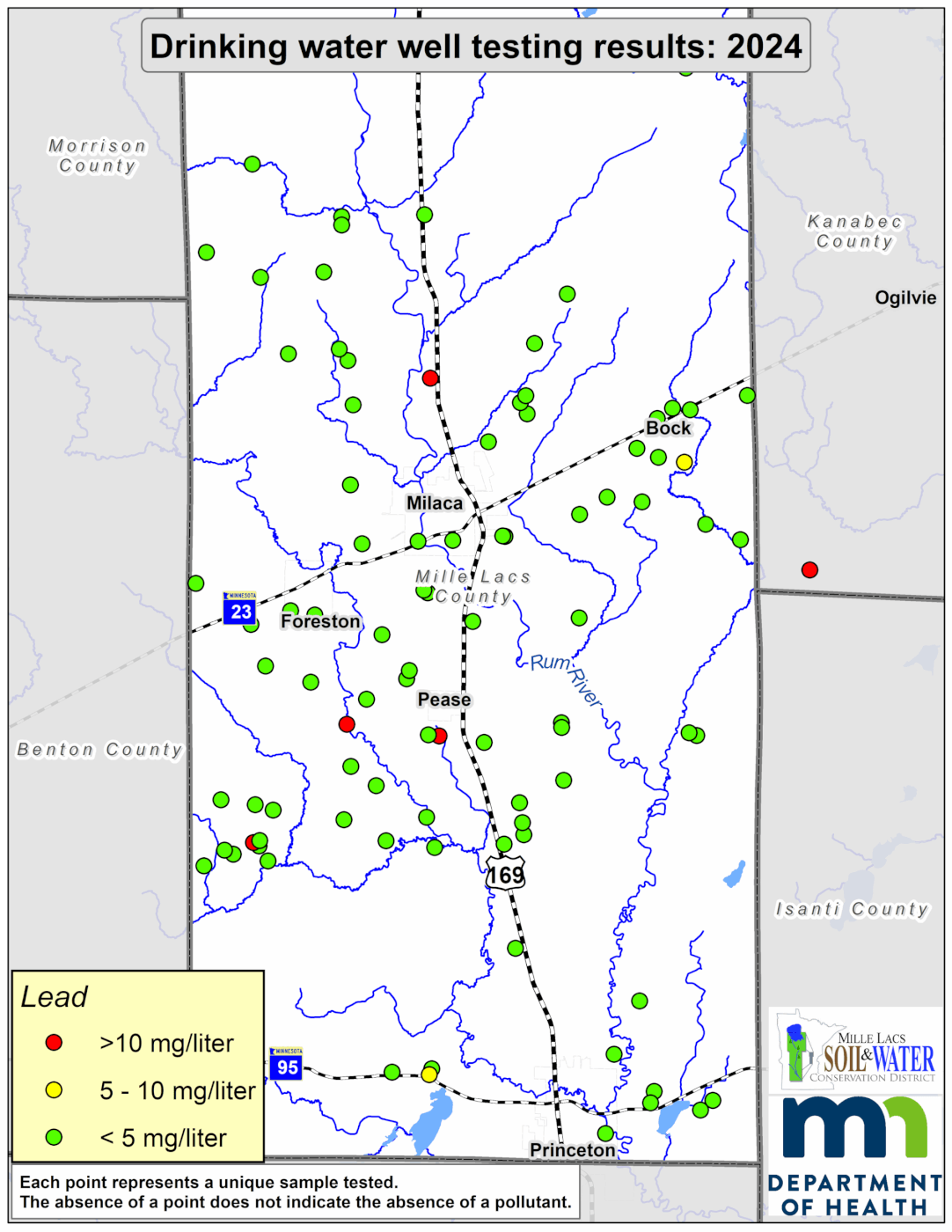
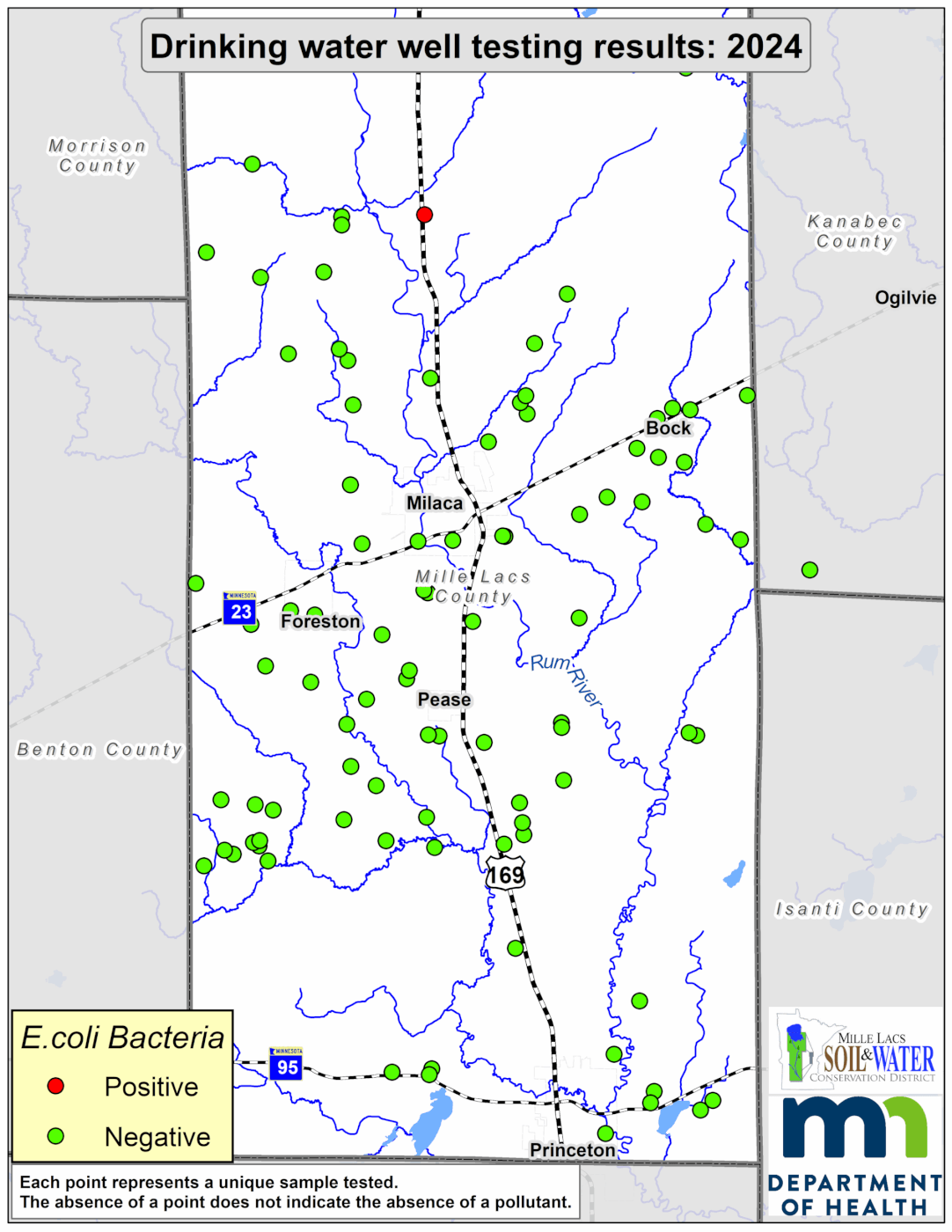
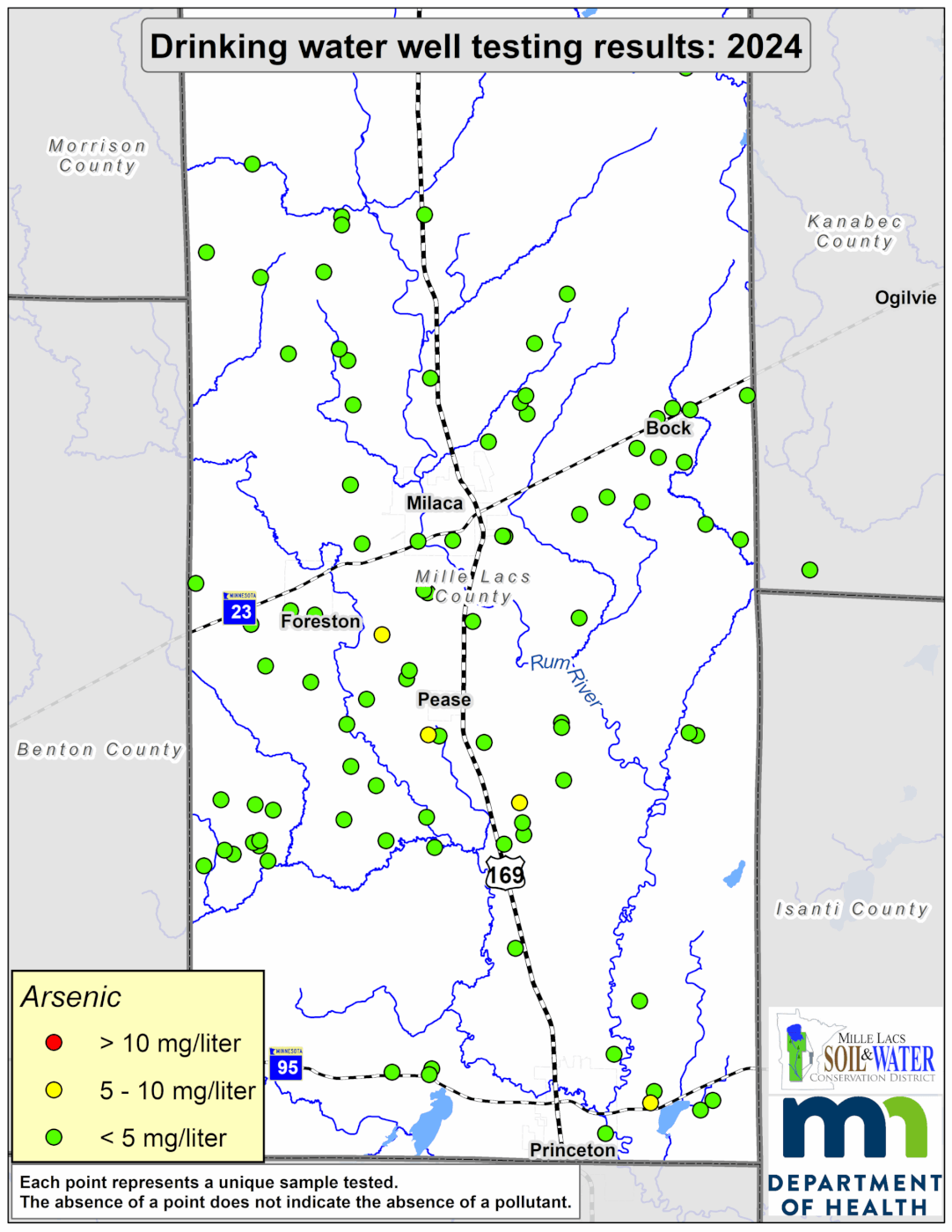
Mille Lacs SWCD has just finished up a grant from the MN Department of Health that allowed us to offer free well water testing to folks in the Milaca area.
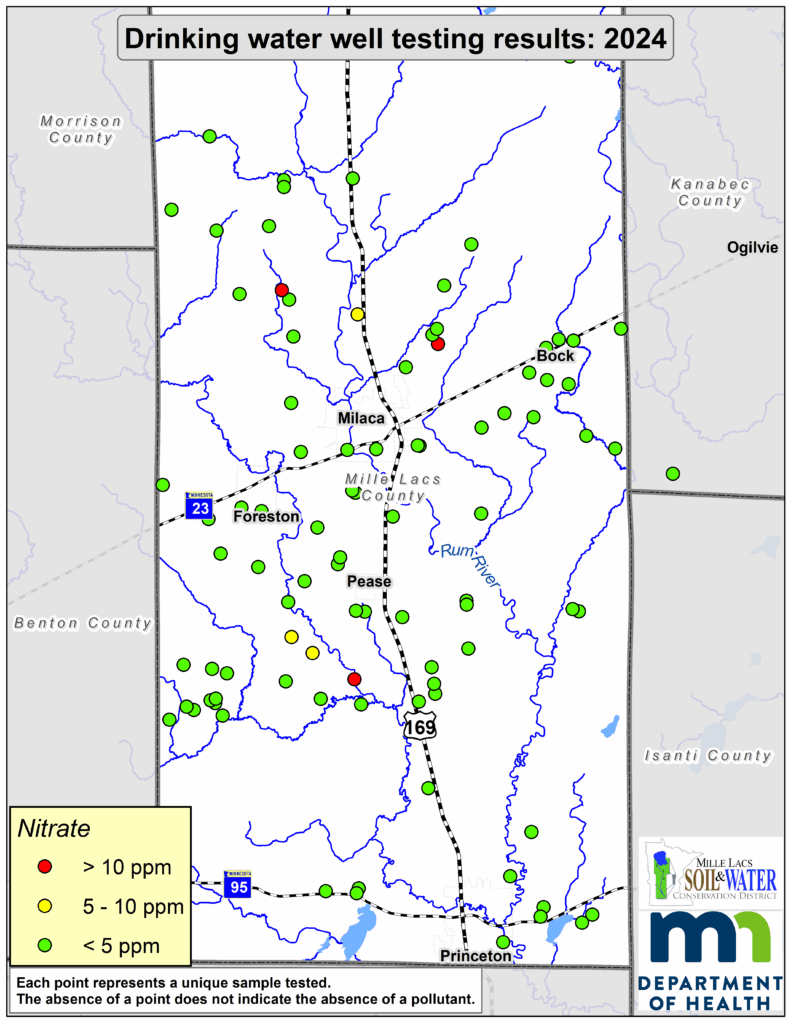
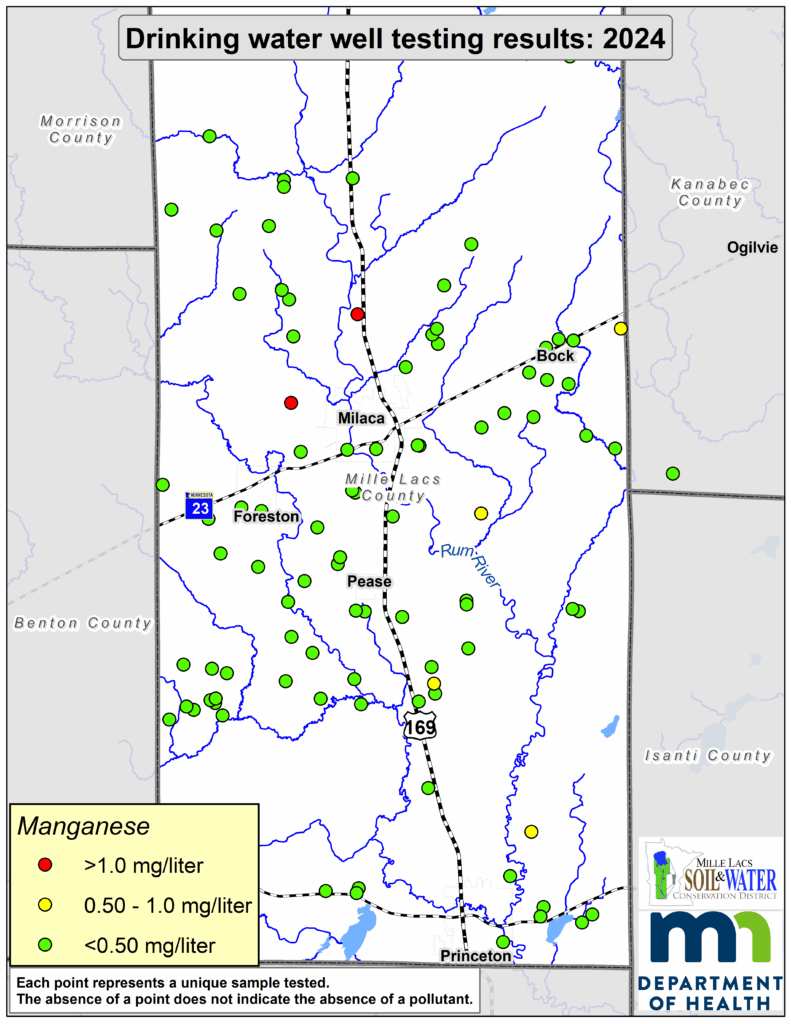
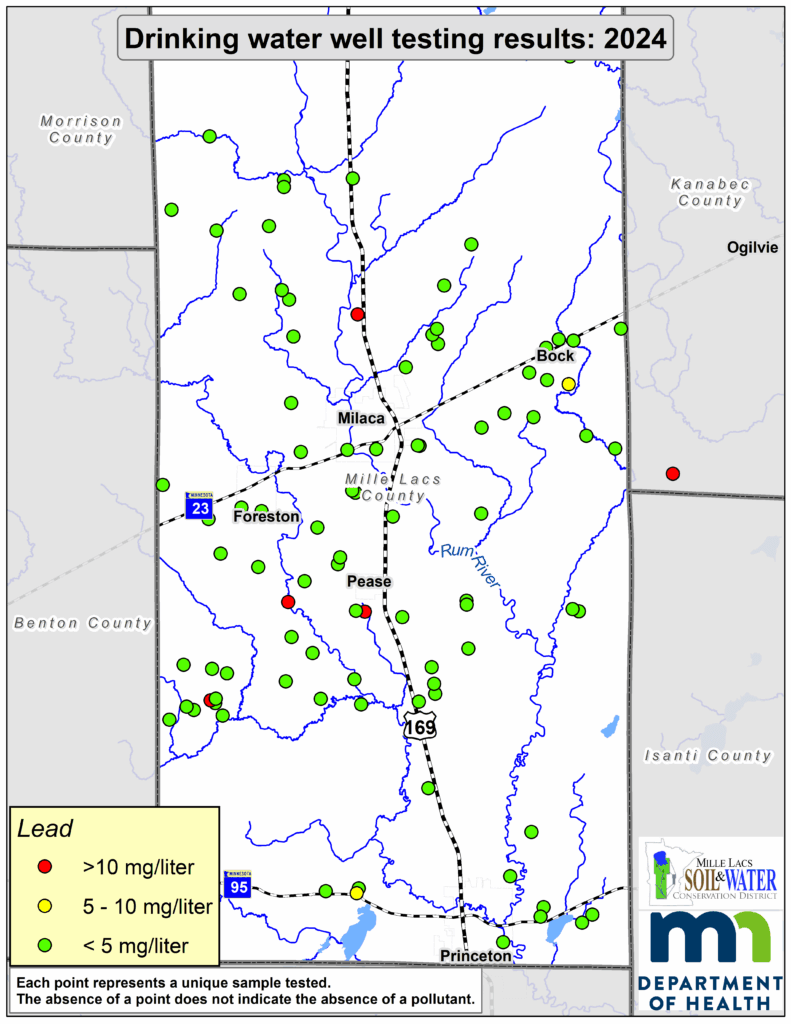
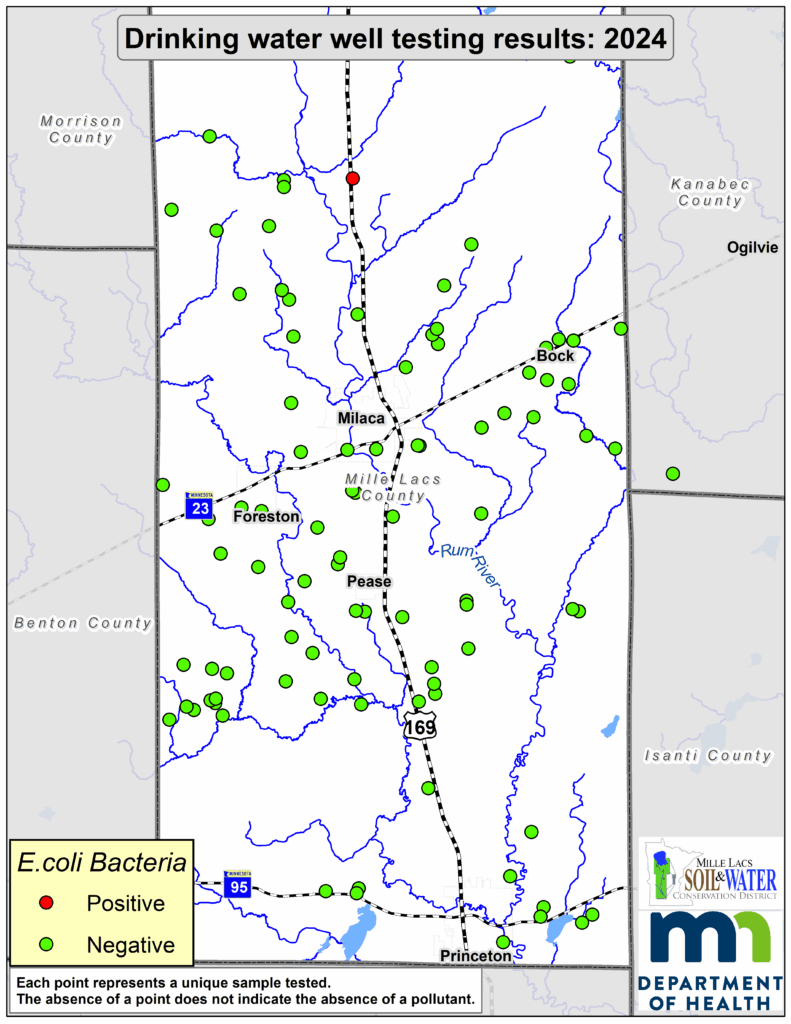
This grant has provided an opportunity to raise awareness among community members about the importance of monitoring drinking water quality and the actions that can be taken to protect drinking water sources. We have assisted many well owners with options and solutions when they found their drinking water tested high in pollutants. It has allowed us to partner with public health personnel, community leaders and citizen stakeholders to reach out to those who may be interested in this opportunity. This grant has been well supported in the community with many requests for testing opportunities in the northern portion of the County. Maps were created that give a snapshot of test results in the target area. These maps are being used to start additional community conversations about drinking water quality awareness.
NOTE: Each point represents a unique sample tested. The absence of a point does not indicate the absence of a pollutant.
Next Steps:
The Mille Lacs SWCD has been awarded a 2025 MDH Groundwater Restoration and Protection Strategies Grant. This grant will offer free well water testing opportunities to residents in the northern part of Mille Lacs County. Watch for more information to be available this summer.
Please contact Lynn Gallice, Shoreline Technician to inquire about water management options and information by calling 320-983-2160 or emailing lynn.gallice@millelacsswcd.org.
Drinking Water Well Testing Results 2024 (NOTE: Each point represents a unique sample tested. The absence of a point does not indicate the absence of a pollutant)

Stormwater Best Management Practices (BMPs)
According to MN legislature, BMPs are “practices to prevent or reduce the pollution of the waters of the state, including schedules of activities, prohibitions of practices, and other management practice, and also includes treatment requirements, operating procedures, and practices to control plant site runoff, spillage or leaks, sludge, or waste disposal or drainage from raw material storage.
Check out the videos below from the Anoka Conservation District to learn more.
You can take steps to do BMPs at home!
Rain Barrels
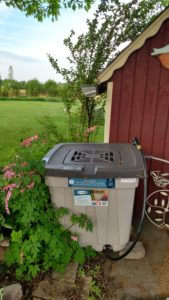
What is a rain barrel?
A rain barrel is any type of container used to catch water flowing from a downspout. Rain barrels reduce the amount of stormwater runoff by collecting roof runoff and storing the rainwater for future use.
How does it work?
The rain barrel is placed underneath a shortened downspout, diverting the roof runoff into the rain barrel. Placing the rain barrel on a STURDY platform will allow for more clearance under the spigot, and it will also increase the rate of flow if you are attaching a hose to the barrel’s spigot.
How do I maintain and rain barrel?
During the spring and summer months routinely inspect your rain barrel. Remove any debris that has accumulated on the lid that might block the screen mesh. You should also routinely clean the inside of your rain barrel. During the winter months, remember to take your barrel out of operation. Simply turn it upside down or store it inside and redirect the downspout away from the foundation.
Benefits of a rain barrel
- They provide an alternative to tap water for watering lawns and flower gardens.
- They will help reduce peak volume and velocity of stormwater runoff reaching lakes and rivers.
- They will help reduce peak water demands during the summer months.
Restrictions on rain barrel use
- Water collected from rain barrels is not suitable for human or pet consumption.
- Due to lack of research data, water collected in a rain barrel is not recommended for watering fruit or vegetable gardens.
- The water flow (and pressure) will be less than from your outdoor spigot, making sprinklers ineffective. Plan to use soaker hoses, handheld spray nozzles and/or watering cans. Elevating your rain barrel on a sturdy platform will increase the flow.
This information above is from the Minnesota Landscape Arboretum: http://www.arboretum.umn.edu/rainbarrel.aspx
Rain Gardens
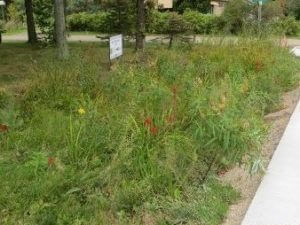
What is a rain garden?
A rain garden is a planted depression, or low area, that allows rainwater runoff from impervious surfaces (like roofs, driveways, walkways, and parking lots) to soak in. Rain gardens also help remove pollutants from water before it enters a local stream.
RAIN GARDENS:
- Prevent erosion by holding soil in place with their deep roots.
- Attract birds and butterflies.
- Require little watering and maintenance once established.
The benefits of rain gardens
Whether you live in the city or along a lake or river, managing stormwater runoff is important. Rooftops, roads, driveways, and sidewalks are hard surfaces that prevent rainwater and melting snow from reaching the soil and soaking into the ground. These hard surfaces also tend to collect nutrient-rich yard and pet debris, oil and radiator fluid from autos, and other debris and pollutants.
During a rain event or snow melt, fast-moving runoff washes the nutrient-rich debris and other harmful pollutants away, often directly into lakes, rivers, and wetlands. The greater amount and increased speed of water flowing off hard surfaces can erode soil and carry it into our surface waters. In the summer, runoff is often warmed as it flows over hard surfaces. If the warm runoff enters lakes and rivers directly, it can affect aquatic life.
A rain garden is one way to address all of these problems. Rain gardens are designed to collect stormwater runoff, preventing the runoff from flowing directly into lakes, rivers, and wetlands. They allow runoff to soak into the soil, filtering out pollutants before entering the groundwater. Rain gardens also allow sediments to settle and plants to absorb nutrients.
This information above is from the University of Minnesota Extension: http://www.extension.umn.edu/environment/water/property-owners/rain-garden/
Please either call or email Lynn at 320-983-216o or lynn.gallice@millelacsswcd.org to discuss water quality monitoring opportunities that may be available to you.
Learn about the Program
The AgBMP Loan Program is a water quality program that provides low-interest loans to farmers, rural landowners, and agriculture supply businesses. The purpose is to encourage agricultural Best Management Practices that prevent or reduce runoff from feedlots, farm fields, and other pollution problems identified by the county in local water plans. For more information on AgBMP Loan Program, click here.
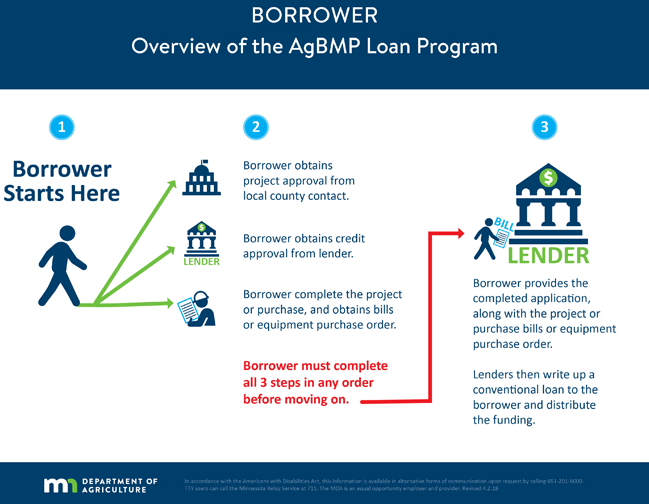
Eligible activities include:
- Feedlot improvements
- Improved manure handling, spreading and incorporation equipment
- Terraces, waterways, streambank protection, sedimentation basins, wind breaks
- Conservation tillage equipment
- Repair of individual sewage treatment systems
- Sealing abandoned wells